For professionals
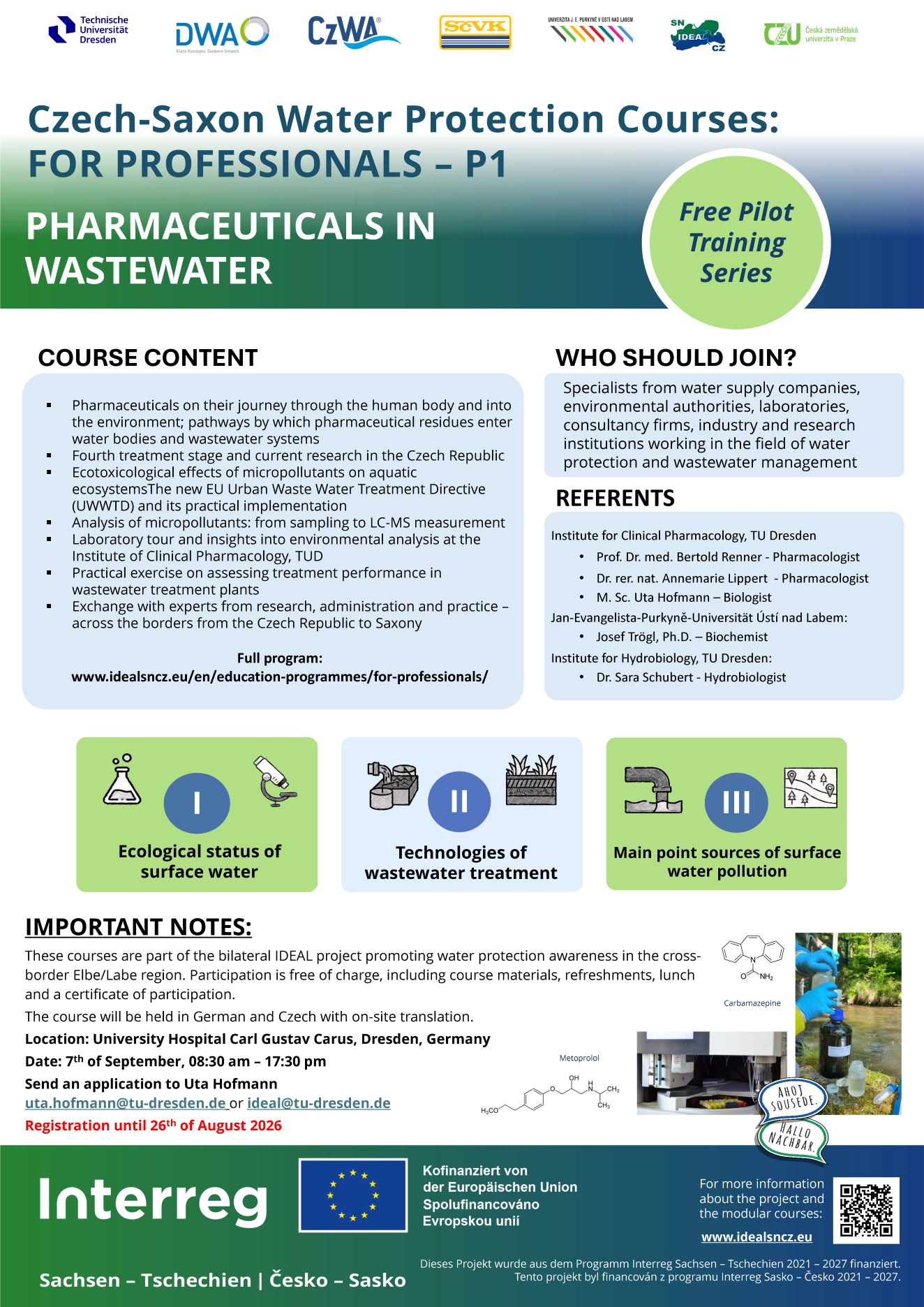
P1 – Pharmaceuticals in Wastewater
7 September 2026 · TU Dresden, Institute of Clinical Pharmacology, Germany
General Course Information
The course is part of the IDEAL project (Interreg SN-CZ), which aims to raise awareness of water protection in the cross-border region of the Elbe/Labe. Participants who complete the course successfully will receive a certificate. There are no course fees (no costs for course materials (de/cz), use of the laboratories, or refreshments/lunch throughout the day). The course will be held in German/Czech.
What will you learn in the course?
- Pharmaceuticals on their journey through the human body and into the environment
- Pathways by which pharmaceutical residues enter water bodies and sewage systems
- Fourth treatment stage in wastewater treatment plants
- Ecotoxicological effects of micropollutants on aquatic ecosystems
- The new EU Urban Wastewater Treatment Directive (UWWTD) and its practical implementation
- Analysis of micropollutants: from sampling to LC-MS measurement
- Laboratory tour and insights into environmental analytics at the Institute of Clinical Pharmacology, TUD
- Practical exercise on evaluating treatment plant performance
- Exchange with experts from research, administration, and practice – across the Czech-Saxon border
Limited to 16 participants.
Registration: Uta Hofmann – uta.hofmann@tu-dresden.de or ideal@tu-dresden.de
Programme Overview
08:30–09:00 | Opening: Pharmaceuticals in Wastewater
Welcome and introduction to the IDEAL-Interreg project, presentation of participating institutions, speakers, and the day’s agenda. Warm-up.
Speaker: M.Sc. Uta Hofmann
09:00–09:45 | From Pharmaceuticals to the Environment – How Medications Pass Through and Leave the Human Body
Pharmaceuticals, their metabolism, and their pathways into sewage systems.
Speakers: Prof. Dr. med. Bertold Renner, Dr. rer. nat. Annemarie Lippert
09:45–10:00 | Coffee Break
10:45–11:30 | From Research to Practice: Innovative Technologies for Pharmaceutical Removal
Insights into modern fourth-treatment-stage processes, an industrial case study with ZODPA, and discussions.
Speaker: Josef Trögl Ph.D.
11:30–11:45 | Coffee Break
Networking within the Water Network.
11:45–12:15 | From Europe to Your Own Region – Understanding the New EU Urban Wastewater Treatment Directive
Introduction to the Urban Wastewater Treatment Directive (KARL), Article 8, indicator substances, and implementation in German and Czech legislation.
Speaker: M.Sc. Uta Hofmann
12:15–12:30 | Buffer Time
12:30–13:15 | Lunch Break
Afternoon Programme
13:15–14:00 | When Pharmaceuticals Meet Ecosystems – Ecotoxicological Effects of Micropollutants
Effects of pharmaceuticals on aquatic organisms and ecosystems, and assessment of ecological risks.
Speaker: Dr. phil. des. Sara Schubert
14:00–14:30 | Analytical Methods for Micropollutants in Wastewater
From sampling and sample preparation to modern analytical methods such as SPE and LC-HRMS: how reliable data is generated from wastewater samples.
Speaker: M.Sc. Uta Hofmann
14:30–15:15 | Laboratory Practice
Practical lab exercises: laboratory tour and demonstration of analytical methods (Group 1); exercise on treatment plant efficiency using real monitoring data (Group 2).
Speaker: M.Sc. Uta Hofmann
Coffee, information materials, and opportunities for exchange.
15:15–16:00 | Laboratory Practice
Practical lab exercises: laboratory tour and demonstration of analytical methods (Group 2); exercise on treatment plant efficiency using real monitoring data (Group 1).
Speaker: M.Sc. Uta Hofmann
Coffee, information materials, and opportunities for exchange.
16:00–16:15 | Understanding the Data – Discussing Results
Evaluation and interpretation of the removal rate calculation.
Speaker: M.Sc. Uta Hofmann
16:15–17:00 | Closing Workshop: Building Bridges Across Borders and Rivers
Reflection on the jointly developed Water Network, future identification of cooperation opportunities, and the role of participants in the German-Czech water system.
Speaker: M.Sc. Uta Hofmann
17:00–17:15 | Feedback, Outlook & Conclusion
Course evaluation, closing reflections, and open questions.
Speaker: M.Sc. Uta Hofmann
17:15–17:30 | Buffer Time
P2 – Ecotoxicological Methods
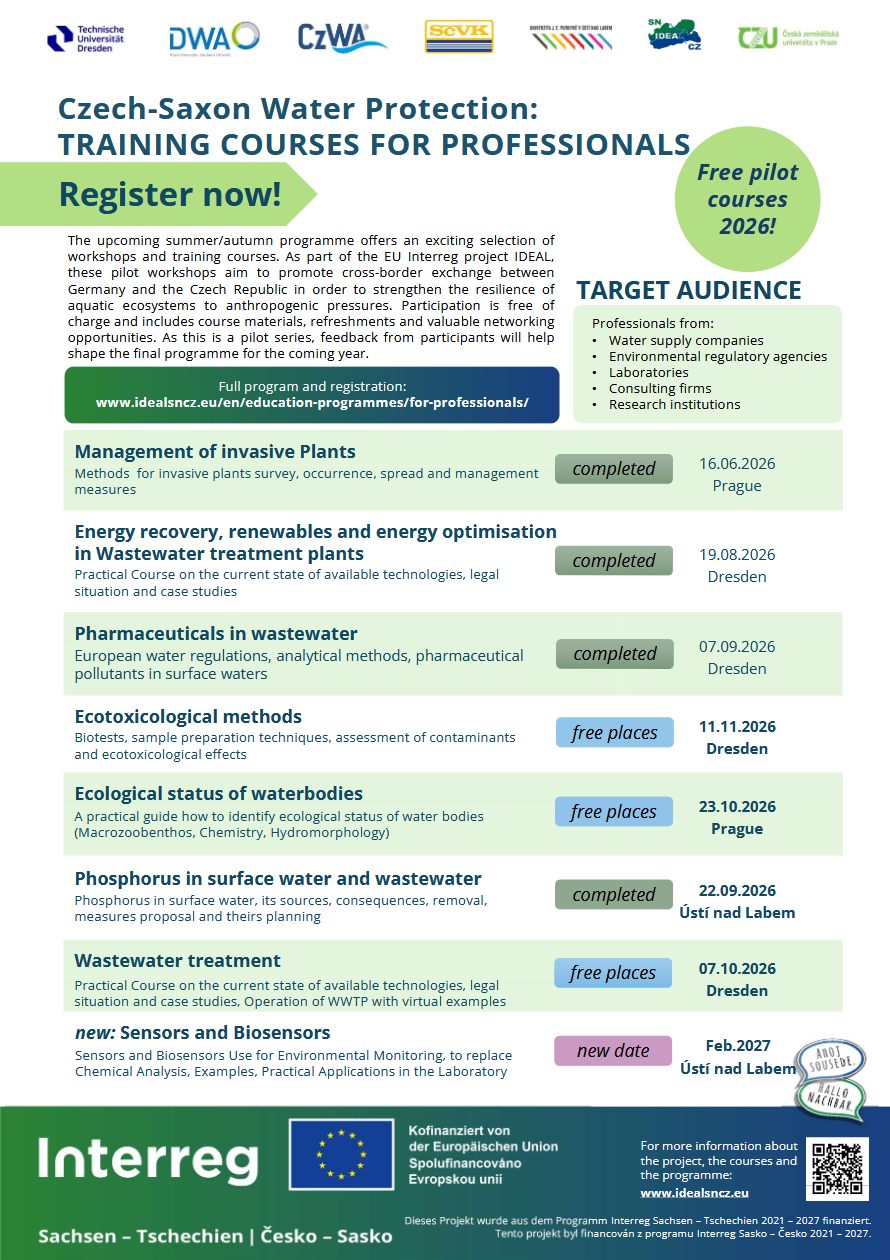
Free pilot course for professionals – 11 November 2026, 8:30–17:30 (in person)
TU Dresden, Institute of Hydrobiology, Dresden, Germany
Target audience
Professionals from water management companies, environmental authorities, laboratories, consulting firms, industry and research institutions working in water protection and wastewater management.
Prerequisites
- Mandatory attendance of the safety briefing at the start of the course
- Welcome: basic laboratory skills such as pipetting, handling and disposal of solutions and substances, working with wastewater as a matrix
- Knowledge of sterile work and work with GMOs is an advantage
General information:
The course is part of the bilateral IDEAL project (Interreg SN-CZ), which aims to strengthen awareness of water protection in the cross-border Elbe/Labe region. You will receive a certificate upon successful completion. Participation is free of charge, including study materials (DE/CZ), use of the laboratories, and refreshments/lunch. The course is held in German and Czech with interpreting provided on site. Accommodation can be arranged on request if needed.
Course content:
- Relevant legal framework at European level (WFD, UWWTD)
- General structure of biological tests – in vivo, in vitro
- Overview of key guidelines for biological tests – OECD, ISO
- Pathways of micropollutants into the aquatic environment
- Emerging pollutants (pharmaceuticals, plasticisers, pesticides, etc.)
- Excursion I: Bitter Pills – pharmaceuticals from patient to water polluter
- Excursion II: Reducing micropollutants through a fourth treatment stage in wastewater treatment plants
- Practical session I: Sample preparation (filtration, solid-phase extraction)
- Practical session II: Identifying river sections polluted by wastewater – using effect-based methods (EBM) such as mutagenicity, hormonal activity and herbicidal toxicity
- Practical session III: Evaluating treatment efficiency in wastewater treatment plants
- Exchange of experience with experts from research, public administration and practice across the Czech–Saxon border
Limited to 16 participants.
Registration by 28 October 2026: Sara Schubert – sara.schubert@tu-dresden.de or ideal@tu-dresden.de
Full programme: www.idealsncz.eu/vzdelavaci-programy/odborna-verejnost/
P7 – Phosphorus in surface waters and wastewater
Main organizer: CzWA
Cooperation: SčVK
Date: 22 September 2026
Location: Ústí nad Labem
Target groups (Czech and German):
- Operators of small wastewater treatment plants
- Water authority staff
- River basin management staff
- Planners/designers
- Czech Environmental Inspectorate
- Water Research Institute (VÚV)
- Students
Number of participants: 50–100
Focus:
The workshop addresses the topical issue of phosphorus in surface waters – its sources, consequences, removal, and the planning of corresponding measures. The main goal of the event is the informal exchange of information, limit values, knowledge, approaches, and procedures on both sides of the border. Participation of speakers and attendees from both countries is intended. The entire event will be simultaneously interpreted.
Topics:
Phosphorus in surface waters and its removal
- Causes of phosphorus in surface waters
- Legislation and limit values in Germany and the Czech Republic
- Main sources of phosphorus
- Technologies for phosphorus removal from wastewater
- Small wastewater treatment plants and phosphorus
- Planning process for measures
- Costs of phosphorus removal
P8 – Biosensors For Environmental Monitoring
Basic Information
Duration: 3 days (1 online, 1 self-study, 1 in-person)
Number of participants: max. 10 students
The course will be taught in English.
Program
Course Objective
Students will gain an overview of biosensors for environmental monitoring with a focus on biosensors using bioreporter microorganisms. They will gain knowledge of the design, use, history, advantages, and disadvantages of environmental biosensors.
Theoretical Part
- Introduction to biosensors, basic principles, history
- Bioluminescence, fluorescence, bioreporters, biosensors based on bioreporters
- Immobilization of biological material for the preparation of biosensors
Laboratory Part
- Estimation of BTEX in water using the Pseudomonas putida TVA8 bioreporter
Requirements / Prior Knowledge
- Mandatory participation in GMO laboratory safety training on the first day of the course (online)
- Basic knowledge of laboratory procedures (e.g., pipetting) and rules for the disposal of common substances and solutions
- Experience with sterile work and working with GMOs is an advantage
- The course can be taken independently and does not follow on from any other course within the module
It is advisable to have your own laptop for data evaluation.