Student Courses
If you are interested in a course, please contact the organizing institution HERE.
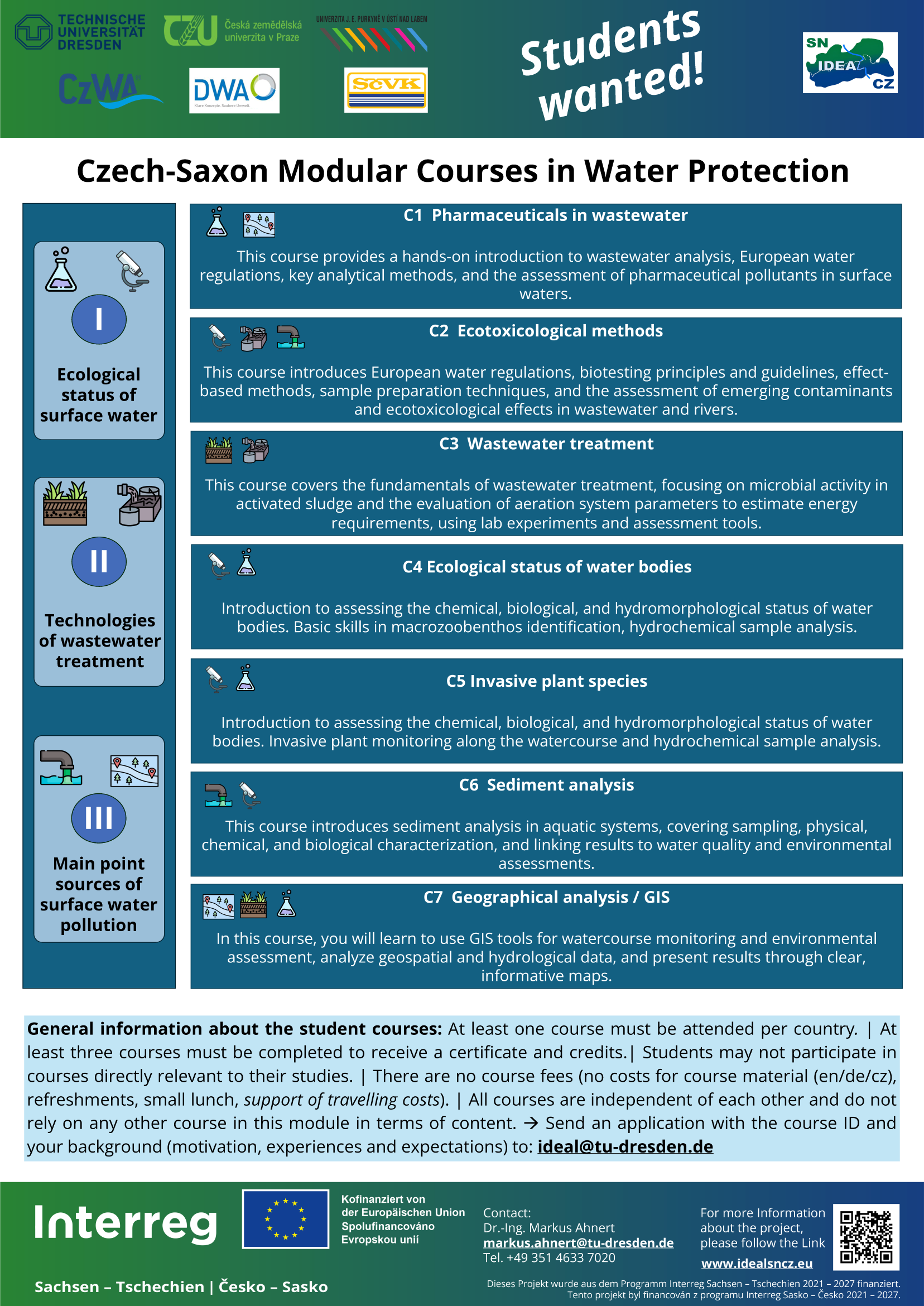
C1 – Pharmaceuticals in Wastewater
This course offers a hands-on introduction to wastewater analysis, European water regulations, key analytical methods, and the assessment of pharmaceutical pollutants in surface waters.
Registration deadline: 9.3. 2026
Begins: 23.3. 2026
C2 – Ecotoxicological Methods
This course presents European water legislation, principles and guidelines of biotesting, effect-based methods, sample preparation techniques, and the assessment of emerging contaminants and ecotoxicological effects in water and rivers.
Registration deadline: 17.8. 2026
Begins: 31.8. 2026
C3 – Wastewater Treatment
This course covers the fundamentals of wastewater treatment with a focus on microbial activity in activated sludge and the evaluation of aeration system parameters to estimate energy demands, using laboratory experiments and assessment tools.
Registration deadline: To be announced
Begins: 26.5. 2026
C4 – Ecological Status of Water Bodies
An introduction to the assessment of the chemical, biological, and hydromorphological status of water bodies. Basic skills in macrozoobenthos identification and hydrochemical sample analysis.
Registration deadline: To be announced
Begins: 22.5. 2026
C5 – Invasive Plant Species
An introduction to the assessment of the chemical, biological, and hydromorphological status of water bodies. Monitoring of invasive plant species along watercourses and hydrochemical sample analysis.
Registration deadline: To be announced
Begins: 21.9. 2026
C6 – Sediment Analysis
This course introduces sediment analysis in aquatic ecosystems, including sampling, physical, chemical, and biological characterization, and linking results to water quality and environmental assessment.
Registration deadline: To be announced
Begins: 7.4. 2026
C7 – Geographic Analysis / GIS
In this course, you will learn to use GIS tools for water resource monitoring and environmental assessment, analyze geospatial and hydrological data, and present results through clear maps and outputs.
Registration deadline: To be announced
Begins: 14.9. 2026
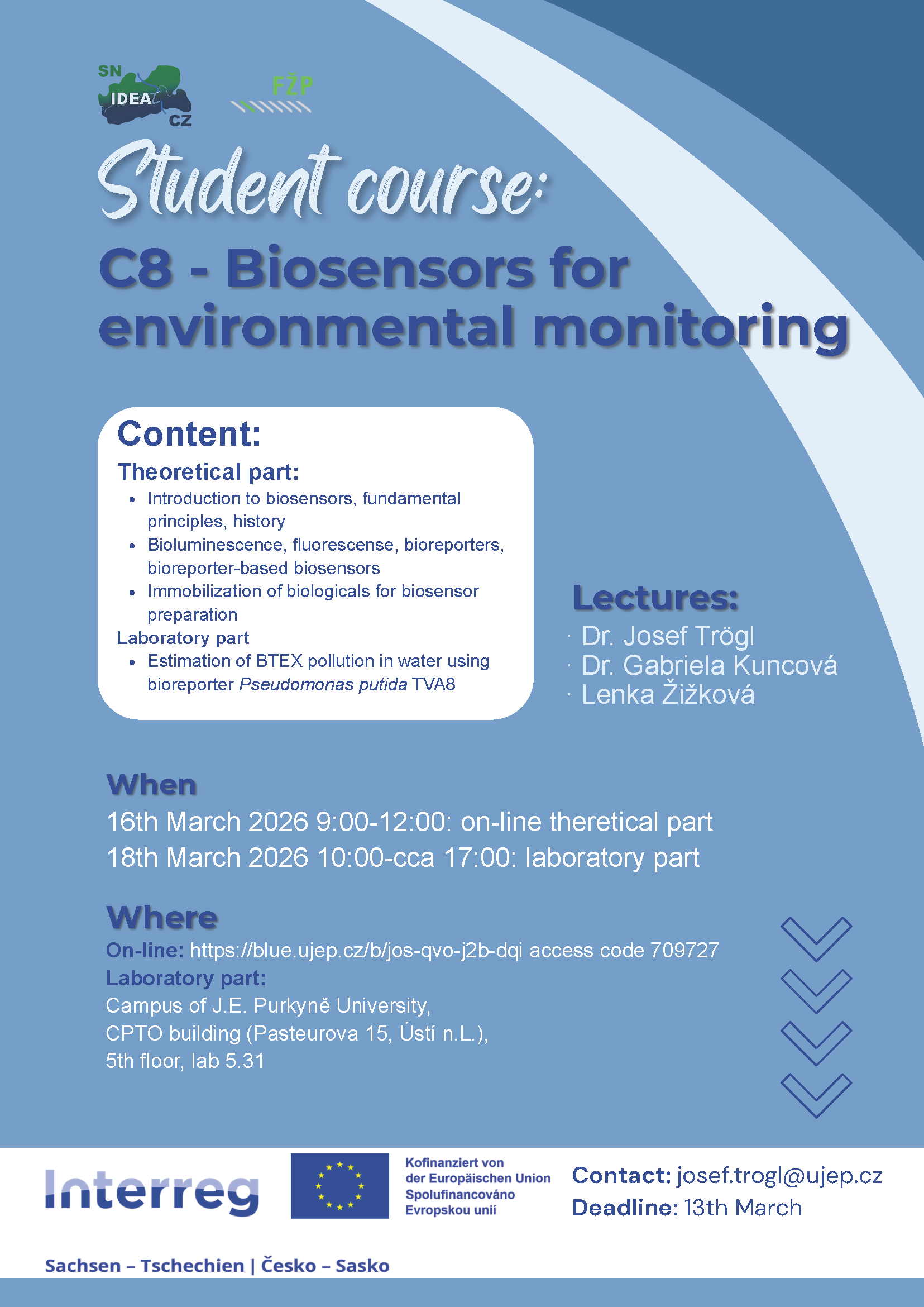
C8 – Biosensors For Environmental Monitoring
Students will gain an overview of biosensors for environmental monitoring with a focus on biosensors using bioreporter microorganisms. They will gain knowledge of the design, use, history, advantages, and disadvantages of environmental biosensors.
Registration deadline: 13.3. 2026
Begins: 16.3. 2026
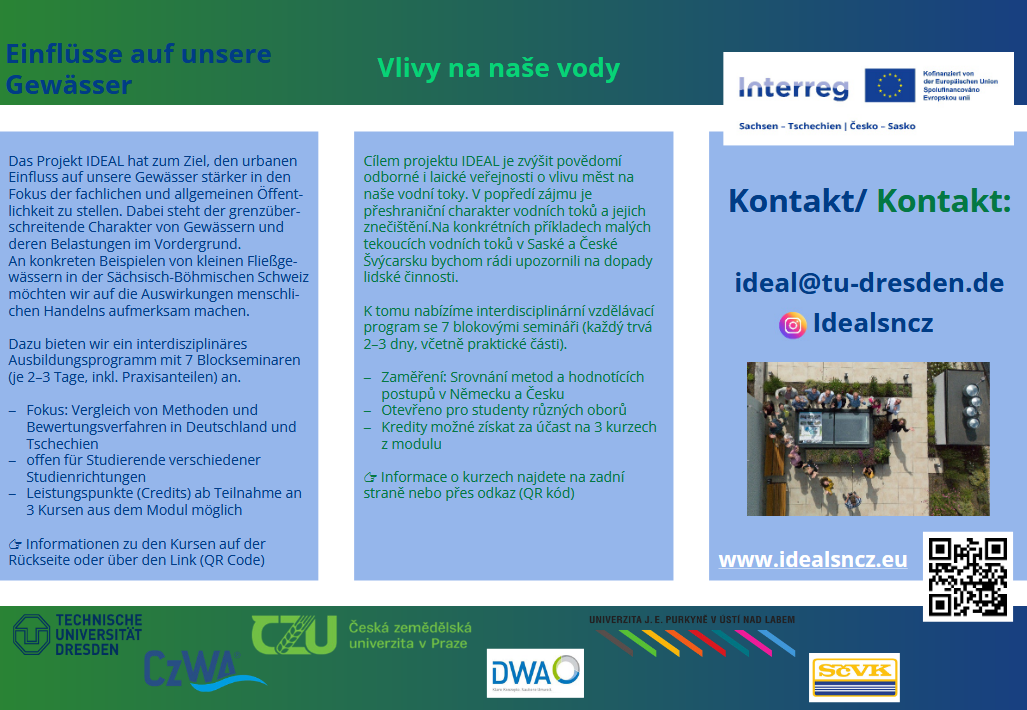
C1 – Pharmaceuticals in Wastewater

Basic Information
Duration: 3 days
Number of participants: max. 16 students
The course will be taught in English. Study materials will also be available in Czech and German.
Program
Course Aim
Students will gain an overview of trace analysis in aquatic environments with a focus on assessing wastewater pollution and will become familiar with the following topics:
- relevant legal frameworks at the European level (WFD, UWWTD)
- general structure of sample analysis procedures
- overview of laboratory guidelines and standard operating procedures (SOPs)
- basic principles of SPE, LC-MS, and data analysis using Excel or R
- origin and biochemical background of pharmaceutical pollutants
- assessment of pharmaceutical pollutant removal in wastewater treatment plants
- identification of river sections polluted by wastewater
Requirements / Previous Knowledge
- mandatory participation in safety training on the first day of the course
- basic knowledge of laboratory procedures (e.g. pipetting) and disposal rules for commonly used substances and solutions
- experience with sterile work and working with GMOs is an advantage
- the course can be taken independently and does not build on any other course within the module
Participants are asked to bring their own laptop with R and RStudio or Excel installed.
Course Schedule
Day 1 – at TUD / in Dresden
approx. 3–4 hours; Monday 13:00–17:30
23 March 2026
- Introduction (participants’ background and expectations)
- Division into 4 groups + assignment of seminar topics
- Introduction to the IDEAL project
- Basic lectures on chemical analytics, micropollutants, and monitoring
- General laboratory and safety instructions
Day 2 – at TUD / in Dresden
Tuesday 09:30–16:30
24 March 2026
- Specific laboratory and safety instructions, lab coats
- Preparation of wastewater samples (filtration, SPE) in parallel groups (10:00–12:30 / 13:30–16:00)
- Demonstration measurements using LC-MS/MS and data analysis in parallel groups (10:00–12:30 / 13:30–16:00)
- Lunch break (finger food, drinks)
- Optional accompanying activity: city tour / boat trip / wine bar (17:30–20:00, self-paid)
Day 3 – online
approx. 1.5–2 hours; Thursday 13:00–15:00
- Optional consultations on seminar topics and data analysis
Day 4 – online
approx. 3–4 hours; Friday
27 March 2026
- Seminar topic presentations
- Data evaluation, calculation of removal efficiency in wastewater treatment plants
- Discussion of results and conclusion
- Short questionnaire, course evaluation
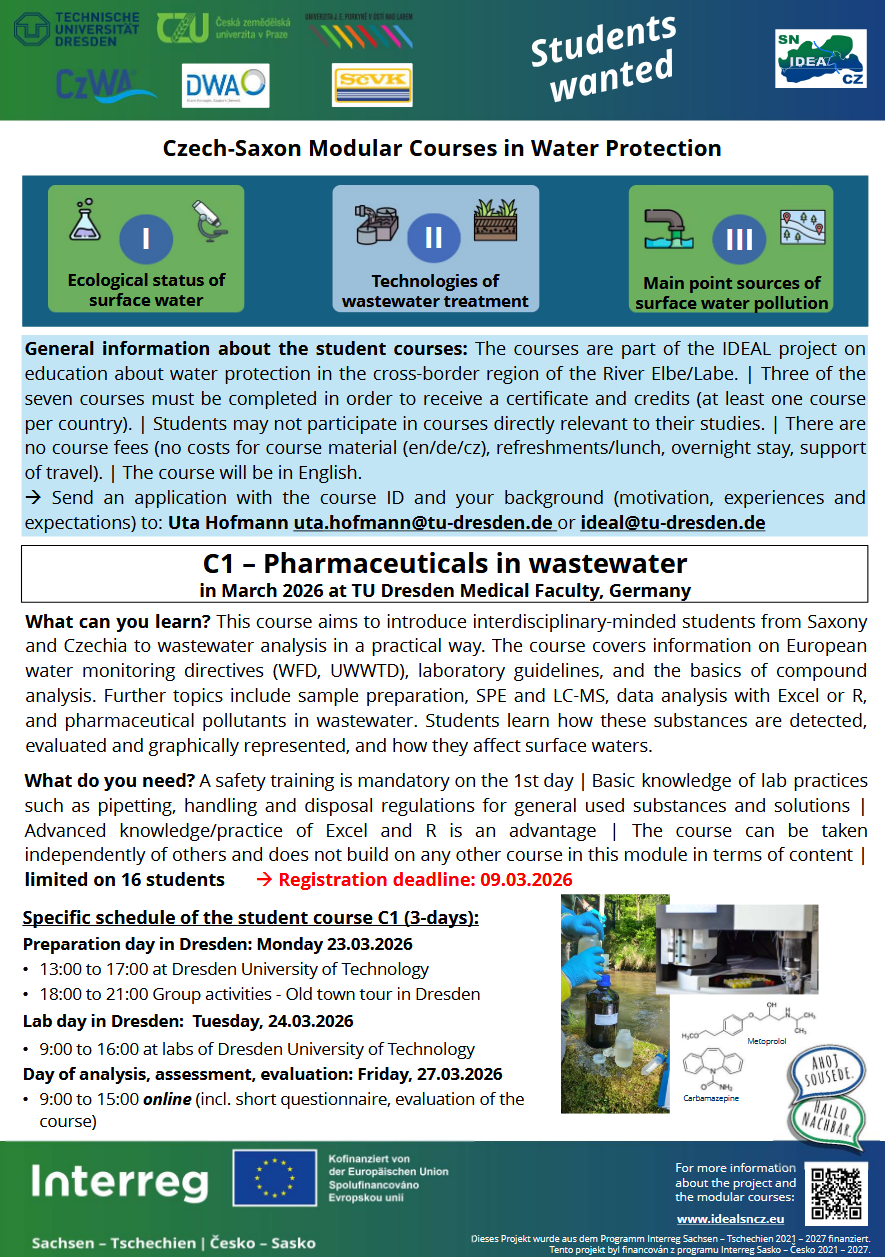
C2 – Ecotoxicological Methods
Basic Information
Duration: 3 days
23. 2. 2025 (online) + 24. 2. 2025 or 25. 2. 2025 (laboratory day) + 27. 2. 2025 (online)
Participants: max. 16 students, divided into 4 groups (for Day 2)
Course Aim
Students will gain insight into aquatic ecotoxicology with a focus on assessing wastewater pollution and will become familiar with:
- relevant legal frameworks at the European level (WFD – Water Framework Directive, UWWTD – Urban Waste Water Treatment Directive)
- general structure of biotests
- overview of key biotest guidelines and methodologies (in vivo and in vitro, OECD, ISO)
- assessment of the reduction of (eco)toxic effects during wastewater treatment
- identification of river sites polluted by wastewater using in vitro biotests
- application of effect-based methods with a focus on mutagenicity, hormonal potential, and herbicide toxicity
Requirements / Previous Knowledge
- mandatory participation in safety training on Day 1
- basic knowledge of laboratory procedures such as pipetting, handling, and regulations for commonly used substances and solutions
- experience with sterile working practices and working with GMOs is an advantage
- the course can be taken independently and does not build on any other course within this module
Course Schedule
Day 1 – online
(approx. 3–4 hours, 09:00–13:00) – 23. 2. 2025
- Introduction (students’ professional background and expectations of the course)
- Division into 4 groups
- Introduction to the IDEAL project
- Basic lectures on ecotoxicology / effect-based methods / biomonitoring
- Safety training
Day 2 – at TUD / in Dresden
(09:30–17:00) – groups 1 and 2 (24. 2. 2025)
- Ames test (09:30–11:45 and 12:45–14:15) – in parallel groups
- Combined algae test (14:30–16:30) – in parallel groups
- Laboratory tour
- Optional additional offer: guided tour of Dresden’s historic city center (17:30–20:00)
Day 2 – at TUD / in Dresden
(09:30–17:00) – groups 3 and 4 (25. 2. 2025)
- Ames test (09:30–11:45 and 12:45–14:15) – in parallel groups
- Combined algae test (14:30–16:30) – in parallel groups
- Laboratory tour
- Optional additional offer: guided tour of Dresden’s historic city center (17:30–20:00)
Day 3 – online
(approx. 5–6 hours, 09:00–15:00) – 27. 2. 2025
- Review of biotesting methods used in the laboratory
- Evaluation of the tests
- Assessment of results and conclusions
- What do these results mean?
- Use of effect-based methods in research, public authorities, and water management
- Short questionnaire, course evaluation
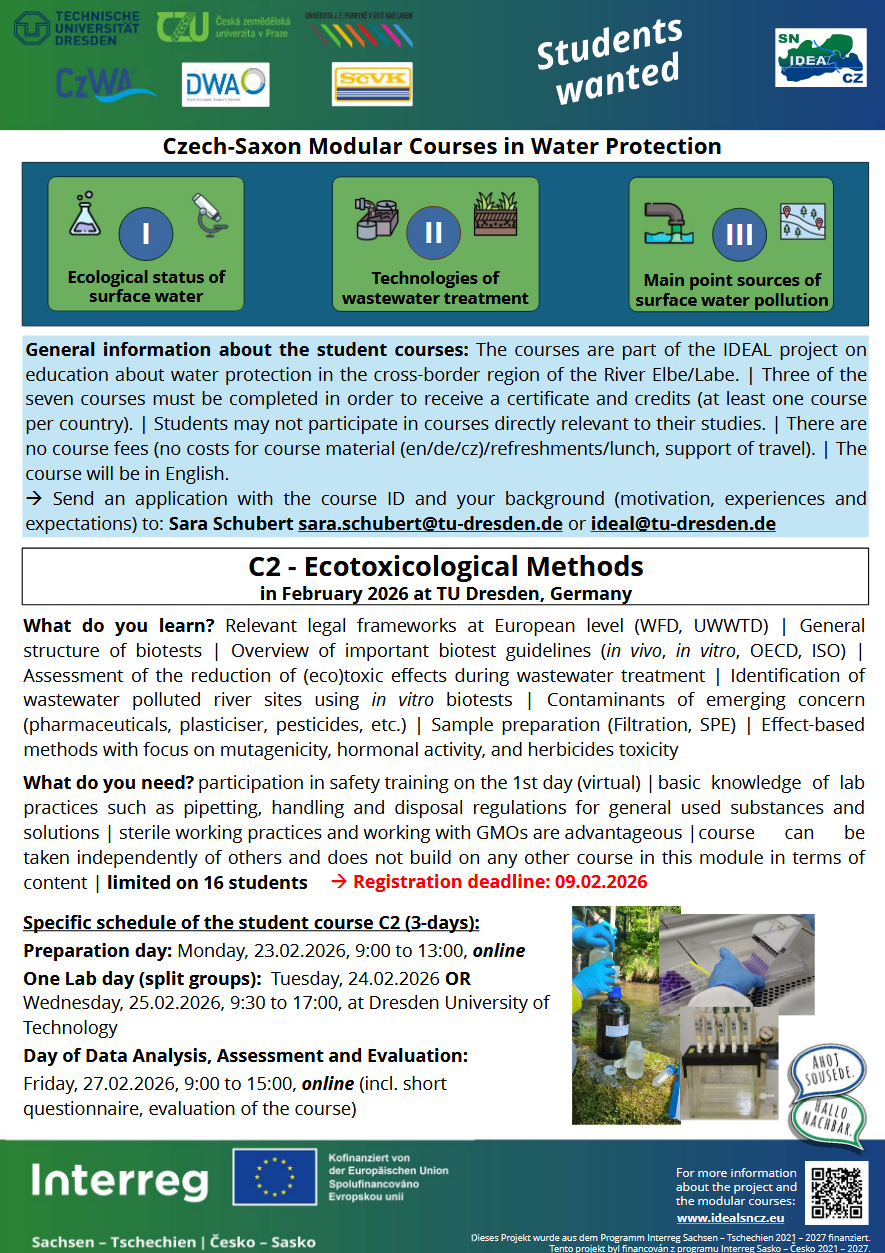
C3 – Wastewater Treatment
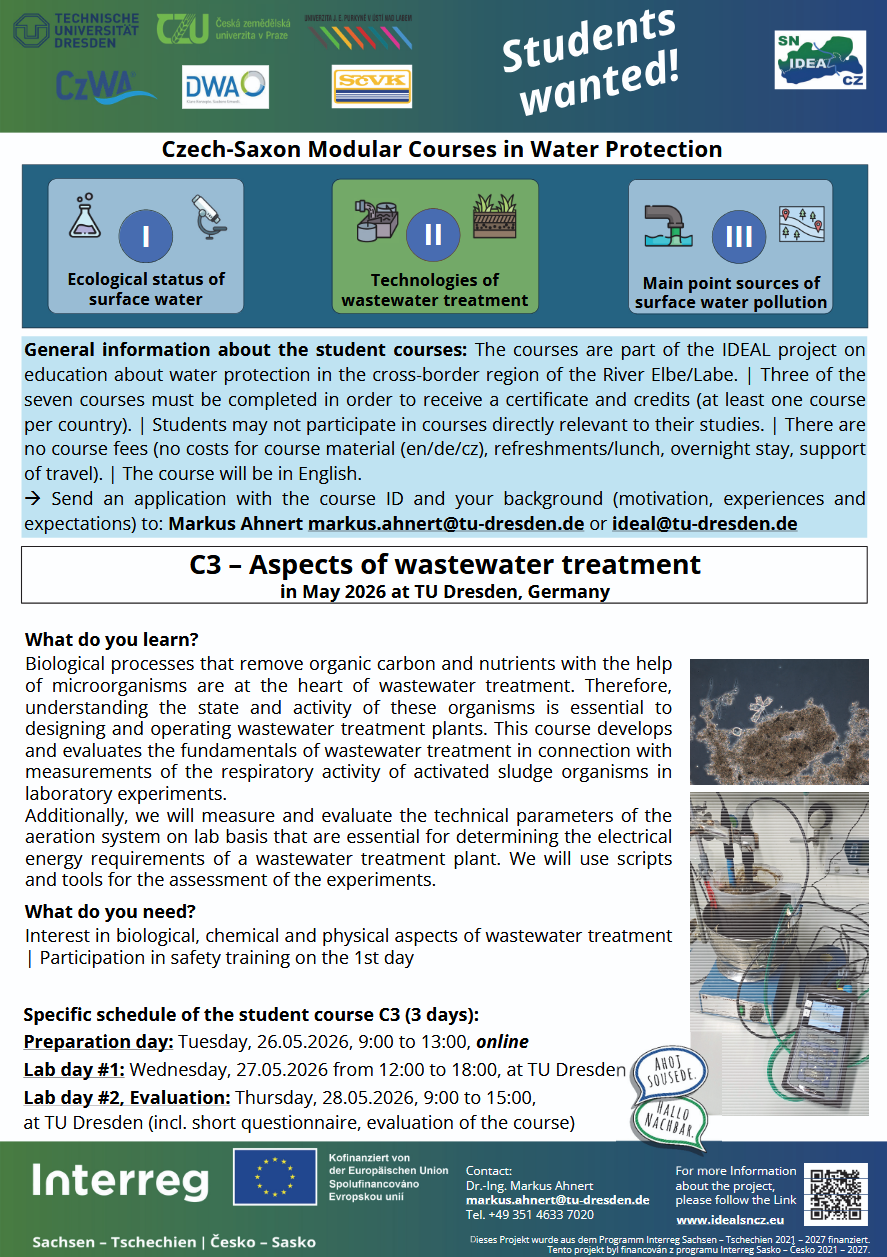
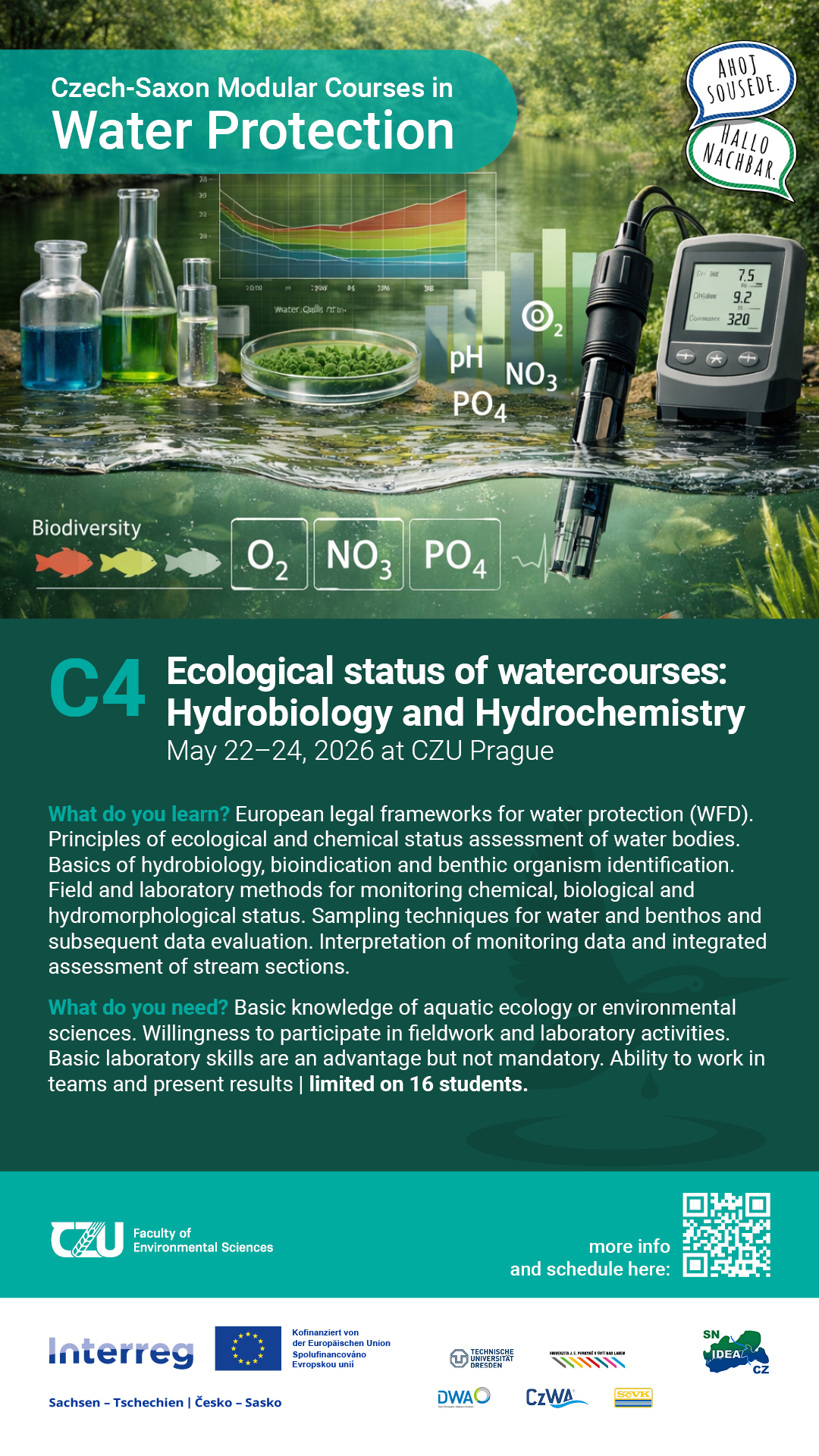
C4 – Ecological Status of Water Bodies

Program
Date: 22–24 May 2026
Day 1
Morning
- Introduction of participants
- Introductory lectures (45 minutes each):
- Water Framework Directive (WFD) and ecological and chemical status of water bodies
- Hydrobiology and bioindication in freshwater ecosystems
- Principles of hydrochemical monitoring of water bodies
Afternoon
- Field trip to a local stream
- Demonstration of monitoring methods used for assessment of:
- chemical status
- biological status
- hydromorphological conditions
Students will:
- collect water samples for hydrochemical analysis
- collect benthic macroinvertebrates for biological assessment
Students will be divided into three groups, each responsible for one section of the stream.
Evening
- Discussion about the fieldwork
- Short campus tour
Day 2
Students remain divided into three groups, rotating between activities (approx. 3 hours each).
1. Hydrobiology
- identification of benthic macroinvertebrates collected during field sampling
- introduction to bioindication methods
2. Hydrochemistry
- laboratory analysis of collected water samples
- demonstration of chemical indicators used in water quality assessment
- analysis of grey water samples from different treatment stages
3. Hydromorphological Assessment
- evaluation of stream habitat structure
- field protocol used in WFD monitoring
Evening
- Walk in Prague
Day 3 – Student Challenge
Morning
Students evaluate the ecological status of their stream section using:
- hydrochemical results
- biological indicators (macroinvertebrates)
- hydromorphological assessment
Afternoon
- Students’ presentations of results
- Discussion of ecological status classification
Evaluation and farewell
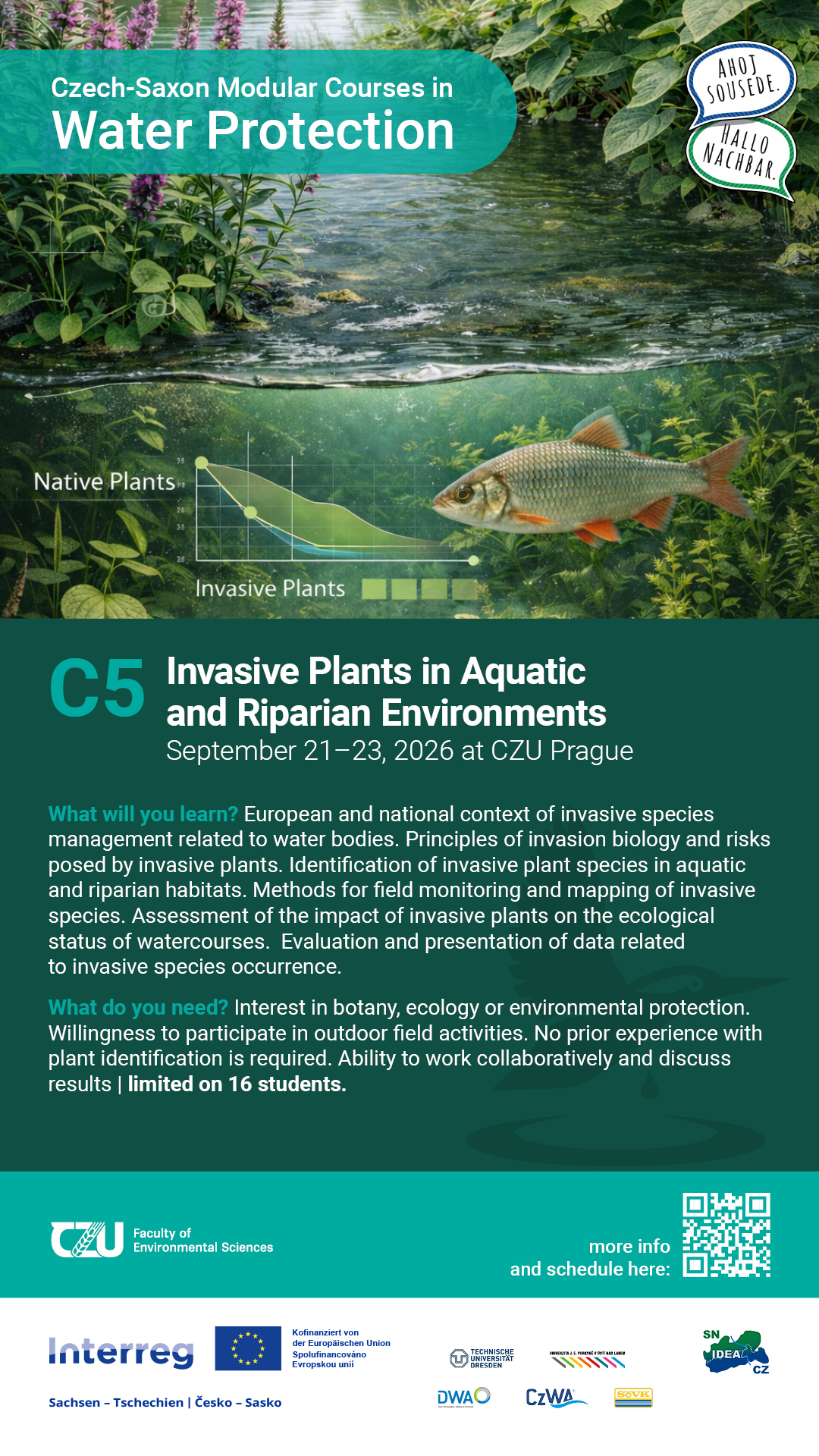
C5 – Invasive Plant Species
Program
Datum: 22.–23. September 2026
Day 1
Morning
- Introduction of participants
- Introductory lectures:
- Invasive alien plants and their ecological impacts
- Risk assessment and management of invasive species
- Monitoring and identification methods
Afternoon
- Field excursion focused on invasive plant species in riparian ecosystems
Students will learn:
- field identification of major invasive plants
- mapping and monitoring methods
- evaluation of ecological impacts
Students will work in small groups and record occurrences of invasive species along selected transects.
Evening
- Discussion of field observations
- Campus walk
Day 2
Morning
- Laboratory session:
- identification of collected plant material
- use of identification keys and monitoring protocols
- discussion of management strategies
Afternoon
- Student group presentations:
- invasive species recorded during field survey
- ecological risk and possible management measures
Final discussion and farewell
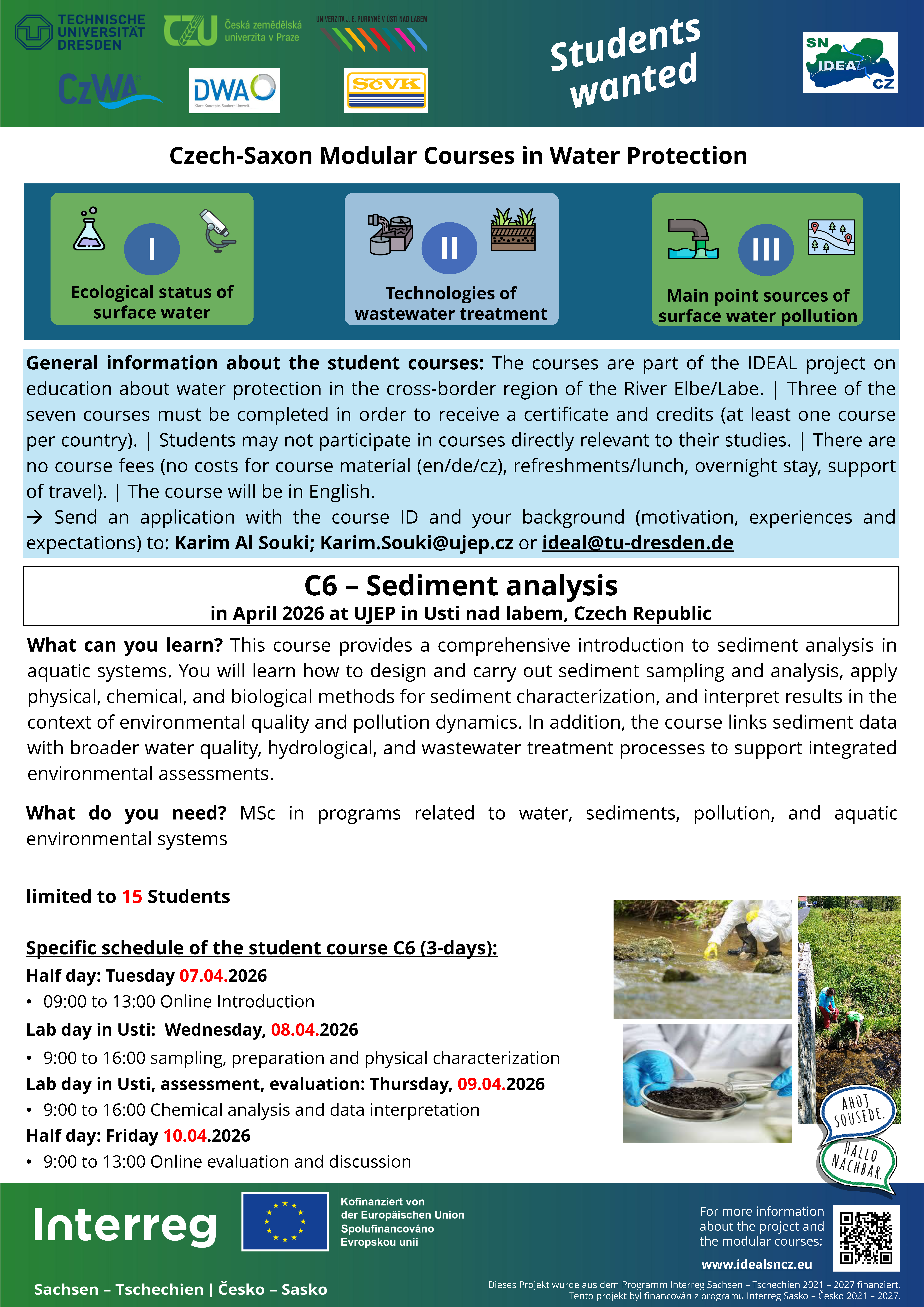
C6 – Sediment Analysis

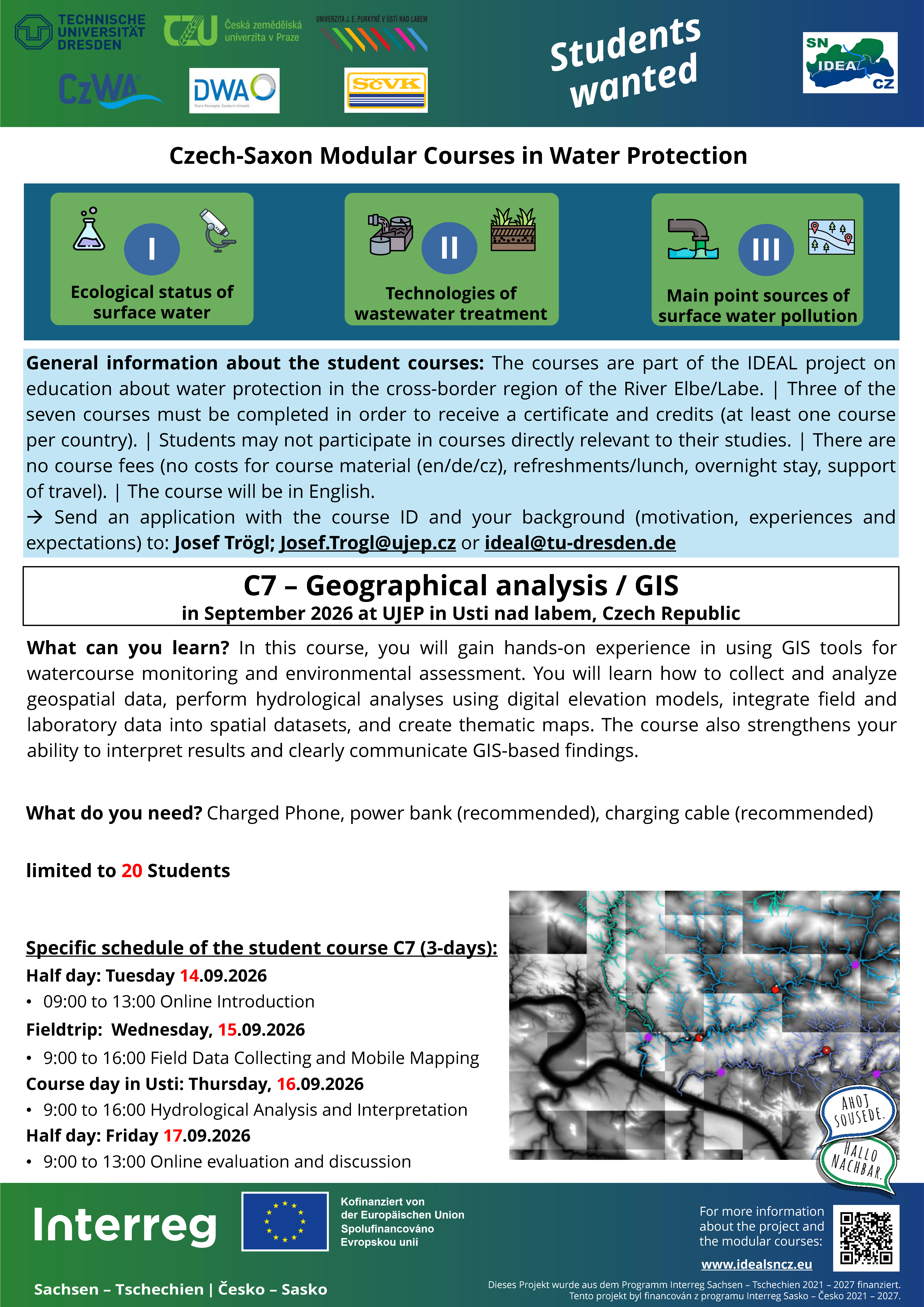
C7 – Geographic Analysis / GIS
C8 – Biosensors For Environmental Monitoring
Course Description
Basic Information
Duration: 3 days (1 online, 1 self-study, 1 in-person)
Number of participants: max. 10 students
The course will be taught in English.
Program
Course Objective
Students will gain an overview of biosensors for environmental monitoring with a focus on biosensors using bioreporter microorganisms. They will gain knowledge of the design, use, history, advantages, and disadvantages of environmental biosensors.
Theoretical Part
- Introduction to biosensors, basic principles, history
- Bioluminescence, fluorescence, bioreporters, biosensors based on bioreporters
- Immobilization of biological material for the preparation of biosensors
Laboratory Part
- Estimation of BTEX in water using the Pseudomonas putida TVA8 bioreporter
Requirements / Prior Knowledge
- Mandatory participation in GMO laboratory safety training on the first day of the course (online)
- Basic knowledge of laboratory procedures (e.g., pipetting) and rules for the disposal of common substances and solutions
- Experience with sterile work and working with GMOs is an advantage
- The course can be taken independently and does not follow on from any other course within the module
It is advisable to have your own laptop for data evaluation.
Course Schedule
Monday, March 16, 2026 – online
9:00 – approx. 12:00 Theoretical part
Followed by self-study
Wednesday, March 18, 2026 – CPTO building on the UJEP campus, Pasteurova 15, Ústí nad Labem
10:00 – approx. 15:00
- Introduction to the laboratory
- Preparation of bioreporter microorganisms for determination
- Calculation of experiment setup (standards, real water, controls)
- Pipetting the experiment into a microtiter plate
- Measurement of bioluminescence response
Followed by self-study – data evaluation and protocol writing with individual online consultation.
Link to webinar
Access code: 709727