Organized by TU Dresden

Students Challenge - Coming soon
IDEAL Student course – Pharmaceuticals in Wastewater (TUD)
Basic Information
Duration: 3 days
Participants: max. 16 students
Lessons will be held in English. Course materials will also be available in Czech and German.
Program
Aim of the course
Students gain insight into aquatic trace analysis with a focus on assessing wastewater pollution and will learn about:
- relevant legal frameworks at the European level (WFD, UWWTD)
- general structure of sample analysis approaches
- overview of laboratory guidelines and SOPs
- basic principles of SPE, LC-MS, and data analysis using Excel or R
- the origin and biochemical background of pharmaceutical pollutants
- assessment of the removal of pharmaceutical pollution in wastewater treatment
- identification of wastewater-polluted river sites
Requirements / Previous Knowledge
- mandatory participation in safety training on the first day
- basic knowledge of laboratory practices such as pipetting and disposal regulations for commonly used substances and solutions
- experience with sterile working practices and working with GMOs is an advantage
- this course can be taken independently and does not build on any other course in this module
Participants are asked to bring a laptop with R and RStudio or Excel installed.
Schedule
1st day – at TUD / in Dresden
ca. 3–4 hours; Monday 13:00–17:30
23.03.2026
- Get to know each other (students’ background and expectations)
- Division into 4 groups + assignment of seminar topics
- Introduction to IDEAL
- Introductory lectures on chemical analytics, micropollutants in wastewater, pharmaceuticals in the UWWTD, and monitoring
- General laboratory and safety instructions
2nd day – at TUD / in Dresden
Tuesday 09:30–16:30
24.03.2026
- Specific laboratory and safety instructions, lab coats
- Preparation of wastewater samples (filtration, solid-phase extraction) in parallel groups (10:00–12:30 / 13:30–16:00)
- Demonstration measurements using LC-MS/MS and data analysis in parallel groups (10:00–12:30 / 13:30–16:00)
- Lunch break (finger food, drinks)
- Optional activity: old town tour / boat trip / wine bar in Dresden (self-funded; 17:30–20:00)
3rd day – online
ca. 1.5–2 hours; Thursday 13:00–15:00
- Optional consultation on seminar topics and data analysis
4th day – online
ca. 3–4 hours; Friday
27.03.2026
- Seminar topic presentations
- Data evaluation and calculation of removal efficiency in WWTPs
- Discussion of results and conclusion
- Short questionnaire and course evaluation
IDEAL Student course – Ecotoxicology (TUD)
Basic Information
Duration: 3 days
23.02.2025 (online) + 24.02.2025 or 25.02.2025 (lab day) + 27.02.2025 (online)
Participants: max. 16 students, divided into 4 groups (for the 2nd day)
Aim of the Course
Students gain insight into aquatic ecotoxicology with a focus on assessing wastewater pollution and will learn about:
- relevant legal frameworks at European level (WFD, UWWTD)
- general structure of biotests
- overview of important biotest guidelines (in vivo and in vitro, OECD, ISO)
- assessment of the reduction of (eco)toxic effects during wastewater treatment
- identification of wastewater-polluted river sites using in vitro biotests
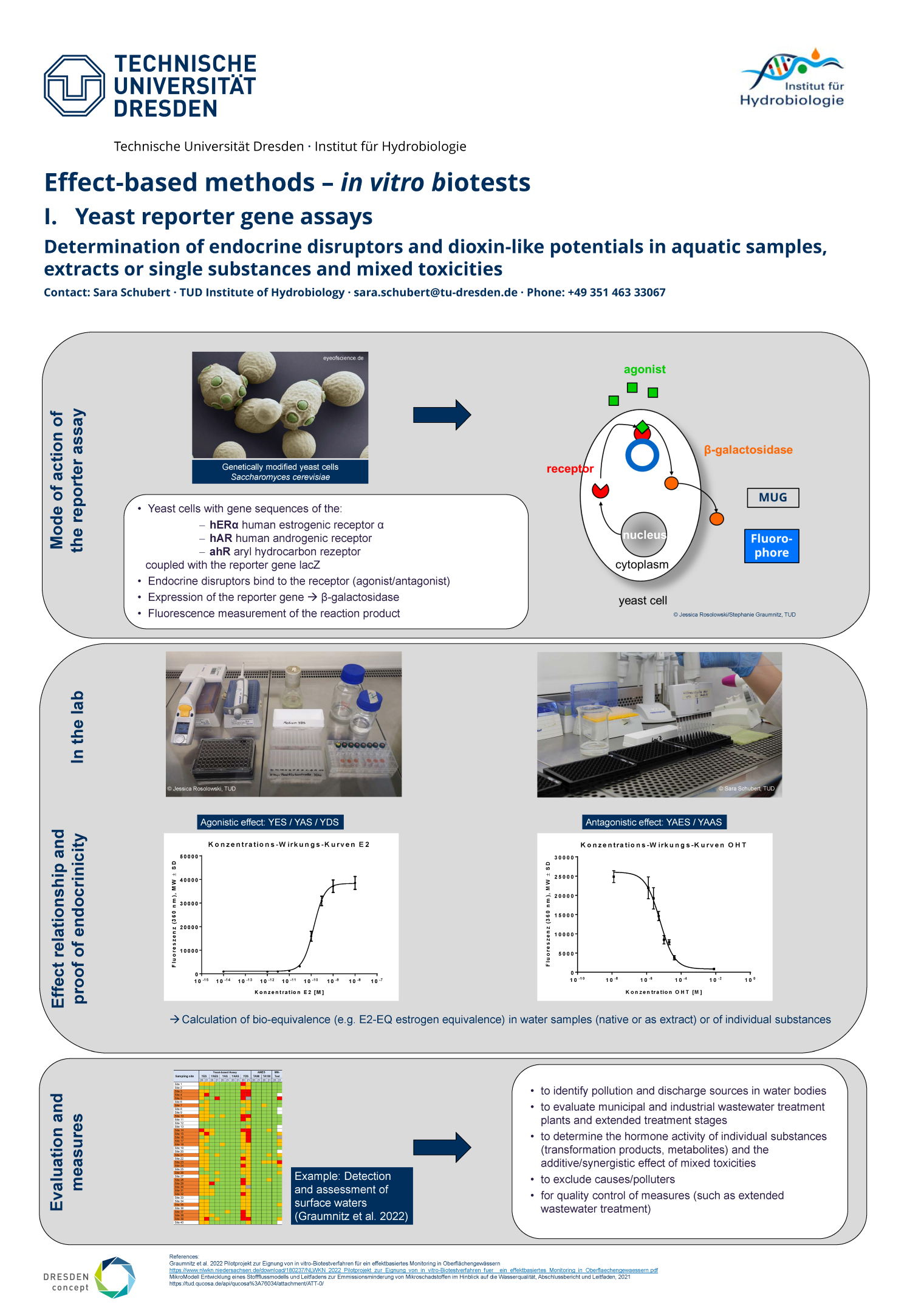
- application of effect-based methods with a focus on mutagenicity, hormonal potential, and herbicide toxicity
Requirements / Previous Knowledge
- mandatory participation in safety training on the first day
- basic knowledge of laboratory practices such as pipetting, handling, and disposal regulations for commonly used substances and solutions
- sterile working practices and experience with GMOs are an advantage
- this course can be taken independently and does not build on any other course in this module
Schedule
1st day – online
ca. 3–4 hours, 09:00–13:00
23.02.2025
- Get to know each other (students’ background and expectations)
- Division into 4 groups
- Introduction to IDEAL
- Introductory lectures on ecotoxicology, effect-based methods, and biomonitoring
- Safety instructions
2nd day – at TUD / in Dresden (Groups 1 and 2)
09:30–17:00
24.02.2025
- Ames test (09:30–11:45 and 12:45–14:15) in parallel groups
- Combined algae test (14:30–16:30) in parallel groups
- Laboratory tour
- Optional activity: old town tour in Dresden (17:30–20:00)
2nd day – at TUD / in Dresden (Groups 3 and 4)
09:30–17:00
25.02.2025
- Ames test (09:30–11:45 and 12:45–14:15) in parallel groups
- Combined algae test (14:30–16:30) in parallel groups
- Laboratory tour
- Optional activity: old town tour in Dresden (17:30–20:00)
3rd day – online
ca. 5–6 hours, 09:00–15:00
27.02.2025
- Review of the biotest methods used in the laboratory
- Evaluation of the tests
- Assessment of results and conclusion
- What do these results mean?
- Application of effect-based methods in research, public authorities, and water management
- Short questionnaire and course evaluation